How care providers screen at volume without lowering the bar
High-volume care hiring can force a trade-off between speed and rigour. Three Nordic providers show how a structured AI first screen removes it.

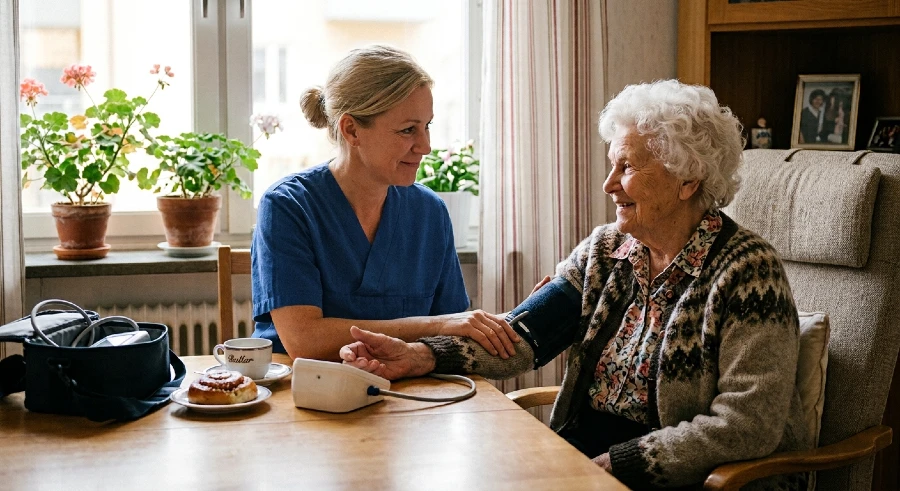
- Structured, competency-based AI interviews let care providers screen at volume while holding the bar that patient-facing roles require.
- At Capio Hemsjukvård, average time-to-hire fell from 32 to 15 days in a pilot, with candidates rating the experience 9 out of 10.
- Ambea cut screening activity by 74% and kept a process explainable to candidates and regulators and built for the EU AI Act.
- Aleris went live in 5 working days, with an 88% interview completion rate and 67% of interviews completed on mobile.
One recruiter. More than 100,000 applications a year. That is the reality at Ambea, the Nordic region's leading care provider, where a single central recruiter supports around 3,000 hires annually. Care hiring runs at a scale that manual screening cannot keep up with.
The stakes are what make it hard - many care roles involve working alone in someone's home with an elderly or vulnerable patient, so a weak first screen can be a patient-safety problem. Care TA leaders need a way to move faster and assess more accurately at the same time. Three Nordic providers show how a structured AI first screen does both.
The real problem in care hiring is accuracy at volume
When hundreds of applications arrive for a single role, careful review by hand becomes unrealistic, and strong candidates get missed. Ambea's Christian Horne described the old trade-off plainly, that at those volumes you end up finding enough candidates rather than the best ones. Speed on its own does not fix that. The first screen has to be consistent, so every applicant is measured against the same bar.
A first screen, fair and comparable for every candidate
Each of these providers put the same step at the front of the process. Every applicant completes a Hubert structured, competency-based AI interview when they apply. Because the Hubert scoring models are deterministic, the same answer produces the same result every time, and recruiters receive a ranked, auditable shortlist directly in their ATS of choice. The interview covers the initial screen. Hiring managers, clinical assessment, reference checks and credential verification stay with people. Hubert shortlists, and the recruiter decides.
Faster, more accurate shortlists at Capio
At Capio Hemsjukvård, which recruits home assistant nurses in the Stockholm region, the original early process asked a lot of candidates and recruiters alike. In a pilot, Hubert replaced parts of that first screen. Average time-to-hire fell from 32 to 15 days, and the longest processes dropped from 90 to 30 days. The resulting shortlists were better matched to the role, giving hiring managers a stronger starting point.
Accuracy improved alongside speed. During one campaign, the team presented 15 to 20 relevant candidates a week, enough that hiring managers actually asked them to slow the pace. Candidates rated the experience 9 out of 10, a score confirmed in both Hubert's reporting and Capio's own post-hire survey in their ATS. Patient safety stayed central throughout, with clinical checks kept in human hands.
Scale and defensibility in one process at Ambea
Ambea runs more than 1,050 care units across Sweden, Norway, Denmark and Finland, with that single recruiter at the centre of it. After a pilot in its Vardaga elderly care division, Hubert's screening went directly into their ATS, Teamtailor and is rolling out across the group.
The result was a 74% reduction in screening activity and around 3 hours saved per recruitment process on average. The majority of applicants rated the experience 10 out of 10. One detail stands out for anyone worried that AI screening pushes people away. A 60-year-old applicant who was nervous about AI completed the process, rated it highly and was hired.
For a care provider, the compliance side matters as much as the time saved. Ambea needed a process that was explainable to candidates and regulators and built for the EU AI Act. Deterministic scoring gives them an audit trail they can stand behind.
Quick to deploy and easy for candidates at Aleris
Speed to value is its own barrier in care, where teams rarely have months to spare. Aleris, one of the Nordic region's largest private healthcare and care providers, went from signing to go-live in 5 working days. Its home care nursing division handles more than 170,000 care visits a month and receives 5,000 applications a year for that unit alone.
The old process depended on a knowledge test that could only run twice a week on location, which created long waits. Replacing it with an interview candidates can complete at any time changed the pattern. 88% of candidates finished the interview, 67% of them on mobile, and satisfaction landed at 9 out of 10. The capacity gain was just as clear. Aleris recruiter Linda Edvardsen described a team that once needed two people to run recruitment now covered by one person across five operational areas.
The takeaway for care TA leaders
Across Capio, Ambea and Aleris, the AI never replaced the recruiter. A consistent first screen allowed each team to handle volume while holding the standard that care roles demand. Recruiters got shortlists they could justify to hiring managers and regulators, and candidates got a flexible experience that they rated highly. The decisions stayed with their recruiters and hiring managers.
If you are hiring care workers at volume and the first screen is where your process strains, that is the step worth rethinking first.